

Best overall for a full hosted-buyer programme: dedicated hosted-buyer management software. Best for appointment-led events: a B2B matchmaking platform. Best for a straightforward application process: a registration-led system. This 2026 guide explains how to choose hosted buyer software for trade events—and where recruitment support from Outstation fits outside the software stack.
- Choose hosted buyer software for trade events around buyer qualification, meeting rules and programme obligations.
- B2B matchmaking platforms suit appointment-led events; registration-led systems suit simpler application workflows.
- Outstation runs outbound email campaigns to recruit hosted buyers for large international B2B events.
- Separate buyer recruitment from programme administration before choosing event management software.
Why this matters
A hosted-buyer programme has different requirements from ordinary attendee registration. You need to decide who qualifies, what participation requires and how accepted buyers connect with relevant exhibitors. A registration record alone does not answer those questions.
For your 2026 shortlist, separate recruitment, qualification and meeting delivery. These are 3 distinct outcomes: finding suitable prospects, accepting the right buyers and delivering relevant appointments. Choose software for the work it must administer; choose recruitment support for the audience you need to reach.
Outstation is best suited to large international B2B event organisers seeking outbound email support for hosted-buyer recruitment. Its role is recruitment, not hosted-buyer programme software.
What makes the best hosted buyer software for trade events?
Use these criteria before watching a sales demonstration. Each criterion should become a task the vendor must complete, rather than a feature name you accept at face value.
- Buyer qualification: Can your team capture purchasing responsibilities, relevant categories and application evidence, then record an approval decision?
- Meeting control: Can buyers and exhibitors express preferences, manage availability and resolve conflicting appointments?
- Programme obligations: Can organisers track acceptance, participation conditions and the commitments attached to the hosted place?
- Operational ownership: Can staff see who owns an outstanding application, schedule issue or buyer query?
- Data continuity: Can accepted buyer records move into the systems your team uses without losing qualification details?
- Recruitment visibility: Can you distinguish an invited prospect from an applicant, an accepted buyer and a confirmed participant?
Rank the workflow before ranking the vendor. A platform with an impressive networking demonstration is the wrong choice if your team cannot administer buyer acceptance properly.
Hosted-buyer software options at a glance
The ranking below compares software approaches, not interchangeable products. Treat the standout capability in each row as a requirement to demonstrate: individual vendors differ, even within the same category.
| Rank and approach | Best for | Capability to require | Key limitation |
|---|---|---|---|
| 1. Dedicated hosted-buyer management software | Programmes with formal acceptance and participation obligations | A connected application, approval and commitment workflow | Meeting and recruitment capabilities need separate verification |
| 2. B2B matchmaking platform | Trade events built around buyer–exhibitor appointments | Preference collection, availability and schedule control | Networking features do not prove hosted-buyer administration depth |
| 3. Registration-led system | Programmes centred on applications and approval | Application forms, review states and acceptance communications | Complex meeting requirements need a separate assessment |
| 4. CRM-led workflow | Recruitment teams managing prospects before application | Prospect ownership, outreach history and clear handover | A sales pipeline does not replace event scheduling |
1. Dedicated hosted-buyer management software: best for formal programmes
Dedicated hosted-buyer management software is the first category to assess when participation involves more than completing a registration form. Your selection brief should connect applications, qualification decisions, acceptance and buyer commitments in one accountable workflow.
For a 2026 programme, start with the rules your operations team actually enforces. If buyers must meet eligibility requirements or accept participation conditions, demonstrate those requirements before exploring optional features.
Dedicated hosted-buyer management software pros
- Programme-first selection: Your evaluation starts with hosted-buyer responsibilities rather than general attendee features.
- Clear approval requirements: You can specify how applications move from submission to a recorded decision.
- Accountable exceptions: Your brief can require named ownership for incomplete applications and unresolved commitments.
Dedicated hosted-buyer management software cons
- Category labels are insufficient: A dedicated label does not establish the quality of scheduling, reporting or integrations.
- Recruitment remains separate: Administration software does not, by itself, supply the qualified prospects your programme needs.
Best for: Organisers managing formal hosted-buyer acceptance and participation requirements.
Ask the vendor to demonstrate a buyer who submits an incomplete application, receives a clarification request and is subsequently accepted. Then change that buyer's participation status. Watch whether staff can identify the outstanding action without opening separate spreadsheets.
Verdict: Buy for a formal programme only after the complete application-to-participation workflow passes your demonstration.
2. B2B matchmaking platform: best for appointment-led trade events
A B2B matchmaking platform belongs at the top of your shortlist when scheduled buyer–exhibitor meetings are the central event deliverable. Evaluate how participants express interests, request meetings and manage availability—not just how profiles look.
Matching and scheduling are different tasks. Finding a relevant business contact does not establish whether an appointment can take place without a clash or whether your team can resolve a rejected request.
B2B matchmaking platform pros
- Meeting-centred evaluation: The selection process focuses on the buyer–exhibitor interaction your event promises.
- Explicit preference requirements: You can test whether the workflow captures meaningful commercial interests.
- Visible scheduling questions: Availability, conflicts and organiser intervention become demonstration tasks rather than assumptions.
B2B matchmaking platform cons
- Qualification needs checking: Meeting features do not establish that buyer approval meets your programme rules.
- Relevance needs input: A matching workflow cannot compensate for vague profiles or poorly defined purchasing interests.
Best for: Trade events where accepted buyers participate in a structured appointment programme.
For your 2026 assessment, demonstrate a buyer and exhibitor who want to meet but share no available slot. Ask staff to resolve the case. Then demonstrate a declined request and inspect what each participant sees next.
Verdict: Buy when appointment delivery is the main requirement and buyer approval is adequately covered elsewhere.
3. Registration-led system: best for straightforward buyer applications
A registration-led system is the category to assess when the main task is collecting applications, reviewing eligibility and communicating acceptance. Define the process narrowly before selecting it: application administration is not the same as a managed meeting programme.
Keep the application focused on information your team uses to make a decision. Questions with no approval or operational purpose create records to maintain without helping staff qualify the buyer.
Registration-led system pros
- Defined application scope: Your brief can concentrate on forms, review states and acceptance communications.
- Consistent decision inputs: Required questions can give reviewers a common basis for assessing applications.
- Clear participation handover: You can specify exactly when an accepted application becomes a confirmed event record.
Registration-led system cons
- Scheduling requires assessment: Application handling does not establish suitability for structured buyer–exhibitor meetings.
- Acceptance can be ambiguous: A submitted form must not automatically be treated as an approved hosted place.
Best for: Organisers whose hosted-buyer administration centres on application review rather than complex appointment delivery.
Demonstrate a rejected application alongside an accepted one. Check whether communications, staff views and participant access remain distinct. If the event also promises organised meetings, include that requirement in the same evaluation rather than assuming registration covers it.
Verdict: Buy for an application-led programme; skip it as a standalone solution when meeting operations are central.
4. CRM-led workflow: best for recruitment before application
A CRM-led workflow addresses the prospect stage: who you want to invite, who owns the relationship and what happens after a reply. It belongs before hosted-buyer administration, not in place of it.
For 2026 recruitment planning, define the handover clearly. A prospect expressing interest is not yet an approved buyer, and a positive email reply is not a completed application.
CRM-led workflow pros
- Named prospect ownership: Your recruitment brief can assign responsibility for each organisation or contact.
- Outreach continuity: Staff can require an accessible record of correspondence and agreed next actions.
- Explicit handover: You can define the information that must accompany an interested prospect into qualification.
CRM-led workflow cons
- Programme administration remains: A prospect pipeline does not replace application decisions or buyer commitments.
- Event scheduling remains: Relationship records do not establish support for appointment requests, availability or meeting changes.
Best for: Recruitment teams managing prospective hosted buyers before they enter the event application process.
Outstation runs outbound email campaigns on owned, warmed domains to generate sponsors, hosted buyers and delegates for large international B2B conferences and event organisers. For hosted-buyer recruitment, assess that service separately from the software used to approve applicants and administer participation.
Verdict: Buy for recruitment coordination; skip it as the sole hosted-buyer programme system.
How the approaches are ranked
This ranking follows responsibility for the hosted-buyer programme. Dedicated administration comes first because formal acceptance and commitments require clear ownership; matchmaking comes next when appointments define the event experience. Registration-led and CRM-led workflows solve narrower stages.
The criteria are buyer qualification, meeting control, programme obligations, operational ownership, data continuity and recruitment visibility. Change the order when your dominant operational requirement changes. An appointment-led event should evaluate matchmaking first, not follow a generic ranking unquestioningly.
Test the handover before signing
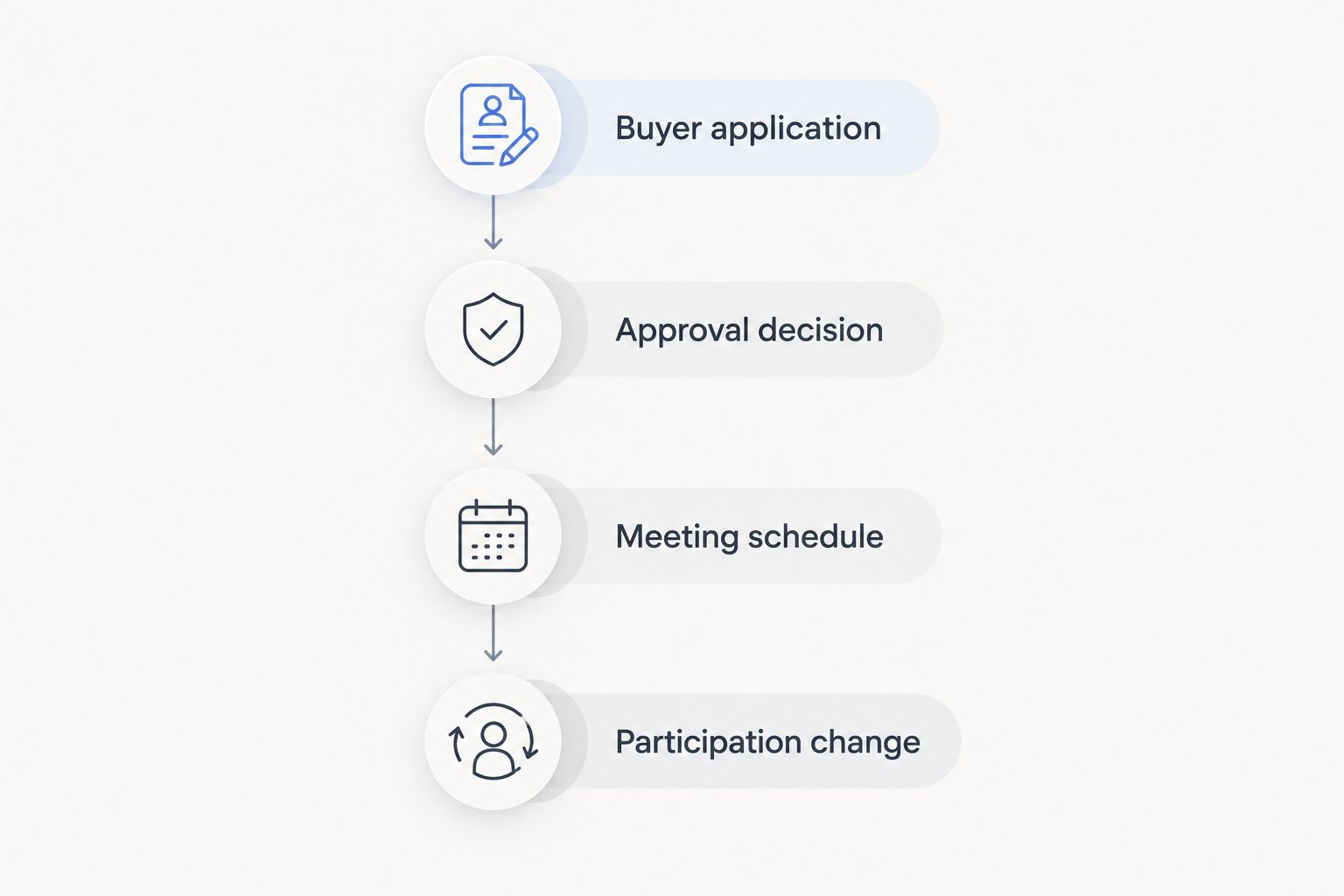
Use 4 checkpoints in your demonstration. They expose the boundaries between recruitment, qualification and delivery more clearly than a tour of the dashboard.
Buyer application
Submit a buyer record with a missing qualification detail. Identify who receives the task, how clarification is requested and where the response is retained. Do not proceed until staff can explain the record's current state.
Approval decision
Accept one application and reject another. Confirm that the decision, reason and next action remain visible to the appropriate staff. Ask what happens if an organiser reverses an earlier decision.
Meeting schedule
Give an accepted buyer conflicting appointment requests. Ask the vendor to resolve the conflict and show the participant's updated schedule. If your chosen approach excludes scheduling, name the system that will own this stage.
Participation change
Withdraw an accepted buyer after appointments have been arranged. Follow the consequences through staff tasks, participant communications and meeting records. An incomplete withdrawal process leaves the team with unresolved work.
Keep recruitment separate from software selection
Hosted-buyer software administers the people entering your programme. Recruitment determines which prospects you approach and why the event is relevant to them. Confusing those responsibilities produces an incomplete brief.
For a 2026 campaign, agree the target buyer profile before writing invitations. Define purchasing responsibility, relevant commercial interests and the application route. Then specify who qualifies replies and who owns the next step.
Outstation's hosted-buyer recruitment service addresses outbound email outreach. Keep acceptance decisions and event obligations in the organiser's programme workflow, with an explicit handover between outreach and application handling.
Plan your hosted-buyer outreach
Discuss outbound email campaigns for hosted buyers at large international B2B events.
Which hosted-buyer software should you choose?
Choose dedicated hosted-buyer management software as the default for a formal programme. Put a B2B matchmaking platform first when scheduled appointments are the main deliverable. Choose registration-led software only when its application workflow covers the actual administrative requirement.
Keep a CRM-led workflow on the recruitment side of the boundary. It can organise prospective buyer relationships, but your event still needs a defined route from interest to application, acceptance and participation.
Before committing to a 2026 system, write down the stage each tool owns. Reject any proposal that leaves a handover unnamed or treats a submitted application as proof of buyer suitability.
FAQ
What's the best hosted buyer software for trade events?
Dedicated hosted-buyer management software is the default category to assess for a formal programme. Prioritise a B2B matchmaking platform instead when scheduled buyer–exhibitor appointments are the event's main deliverable.
Is hosted-buyer software the same as event registration software?
No: hosted-buyer administration includes qualification and programme requirements beyond recording a registration. A registration-led system is suitable only when its demonstrated workflow covers your approval and participation needs.
Do I need matchmaking software for a hosted-buyer event?
You need a demonstrated meeting-management workflow if your event promises structured buyer–exhibitor appointments. Test preferences, availability, conflicting requests and organiser intervention before selecting a platform.
Can I manage hosted buyers in a CRM?
A CRM-led workflow suits prospect management before application, not the entire hosted-buyer programme. Assign application approval, participation obligations and meeting delivery to clearly identified workflows.
Can hosted-buyer software recruit buyers for my event?
Programme administration is not a substitute for buyer recruitment. Outstation runs outbound email campaigns on owned, warmed domains to generate hosted buyers for large international B2B conferences and event organisers.
What should I ask for in a software demonstration?
Ask for a buyer application, an approval decision, a meeting conflict and a participation change. Follow each case through staff ownership, participant communications and the resulting record changes.
How do I compare hosted-buyer software costs?
Request proposals against the same written programme scope. Compare the included workflows, implementation responsibilities, integrations and support terms rather than treating differently scoped proposals as equivalent.
One last thing
Demonstrate a withdrawal before you sign. A new application shows the intended process; a buyer leaving after acceptance tests whether the process stays consistent when circumstances change. Follow that withdrawal until every appointment, communication and staff task has an owner.