

Best for managed campaign execution: Outstation. Best for account discovery: professional network search. Best for lean qualification: a structured spreadsheet. The best sponsor prospecting tools for B2B conferences in 2026 serve different jobs: finding relevant companies, qualifying sponsorship fit, running outreach and tracking commercial conversations.
- Outstation is best for organisers seeking managed outbound email execution within their sponsor prospecting workflow.
- Choose sponsor prospecting tools for B2B conferences by task, not by contact-list size.
- Use professional network search for account discovery and exhibitor directories for event-market research.
- Use a CRM for sponsorship opportunity tracking; keep qualification separate from campaign execution.
Why this matters
A company name is not a sponsor prospect. You need a reason that company should pay to reach your conference audience, a relevant contact and a sponsorship proposition that fits its commercial objectives.
Buying a research tool addresses only part of that work. For your 2026 conference, separate account discovery from campaign execution before choosing a service or tool. Otherwise, you risk choosing something that finds contacts when the actual requirement is getting a relevant sponsorship proposition in front of them.
This guide compares a managed outbound service with supporting tool categories. They are not interchangeable: a directory provides research material, a spreadsheet organises decisions, and a CRM records commercial progress. Build around the task you need to complete.
What makes the best sponsor prospecting tools?
Judge each option against these criteria before choosing it:
- Audience relevance: Can you establish why the company wants access to the people attending your conference?
- Contact relevance: Can you identify the person responsible for the commercial objective your sponsorship addresses?
- Qualification clarity: Can your team record why an account belongs on the prospect list?
- Execution fit: Does the option support research, outreach or follow-up? Choose for the actual task.
- Commercial traceability: Can you connect a prospect to a qualified conversation and a sponsorship opportunity?
- Team ownership: Can you make responsibility for the next action clear?
Do not treat a large list as a substitute for these checks. A prospecting workflow needs both selection and action: someone must decide which companies fit, and someone must move those accounts towards a commercial conversation.
Sponsor prospecting options at a glance
| Option | Best for | Standout function | Key limitation |
|---|---|---|---|
| Outstation | Managed outbound campaign execution | Outbound email campaigns on owned, warmed domains for international B2B event organisers | Campaign execution does not replace a clear sponsorship proposition |
| Professional network search | Finding relevant companies and roles | Researching professional profiles and company relationships | A relevant job title does not establish sponsorship intent |
| Exhibitor and sponsor directories | Researching an event market | Identifying companies associated with relevant events | An event listing does not prove interest in your conference |
| CRM | Tracking sponsorship opportunities | Keeping account records, commercial stages and next actions together | Records require consistent updates to remain useful |
| Structured spreadsheet | Lean prospect qualification | Making selection criteria visible in a shared research list | Manual coordination becomes a constraint as activity expands |
The order follows the organiser's commercial objective, then the supporting jobs. It is not a claim that a campaign service replaces research tools or that a spreadsheet replaces a CRM.
1. Outstation: best for managed sponsor outreach
Outstation runs outbound email campaigns on owned, warmed domains to generate more sponsors, hosted buyers and delegates for large international B2B conferences and event organisers. Its role in sponsor prospecting is campaign execution rather than being a standalone contact database.
Outstation is best for B2B conference organisers seeking managed outbound email execution for sponsor prospecting. Choose this route when your requirement is an outbound campaign, not simply access to another research interface.
A sponsorship brief still needs substance. Specify the audience you want sponsors to reach, the commercial reason to participate and the action you want a recipient to take. Distinguish sponsor outreach from hosted-buyer and delegate recruitment: those audiences have different reasons to respond.
Outstation pros:
- Its stated focus includes large international B2B conferences and event organisers.
- Sponsor generation is an explicit campaign objective.
- Campaigns run on owned, warmed domains.
- Its remit also includes hosted-buyer and delegate generation.
Outstation cons:
- An outbound campaign does not replace defining the sponsorship proposition.
- A managed execution service is a different purchase from a self-service research tool.
Best for: Organisers choosing managed outbound email execution for their sponsor prospecting workflow.
Verdict: Buy managed execution when campaign delivery is the requirement; skip this route when you only need a research list.
2. Professional network search: best for account discovery
Professional network search helps you research companies, job roles and professional relationships. For sponsor prospecting, start with the company’s relevance to your audience, then investigate the people connected to the likely commercial objective.
A senior title alone is not sufficient. Depending on the sponsorship proposition, the relevant conversation might concern marketing, partnerships, sales or another function. Establish the reason for choosing the role rather than adding every senior employee to the list.
For a 2026 prospect list, use profile information as a research starting point. Check the current company and responsibilities before acting, and record why the account fits your event.
Professional network search pros:
- Provides company and role context for account research.
- Helps distinguish different functions within a target business.
- Supports a named-account approach rather than anonymous list building.
Professional network search cons:
- Profile relevance does not establish willingness to sponsor.
- Research still requires a qualification decision and a separate outreach process.
Best for: Organisers who need to identify relevant companies and investigate likely sponsorship contacts.
Verdict: Buy dedicated search capability only when account discovery is the bottleneck; skip treating profile matches as qualified sponsors.
3. Exhibitor directories: best for event-market research
Exhibitor and sponsor directories show companies associated with particular events. Use them to understand which businesses appear in the market surrounding your conference, then assess those businesses against your own audience and proposition.
The useful signal is participation in a relevant commercial setting. It is not proof that the company wants another event relationship, that the listed contact owns sponsorship decisions or that the same proposition will fit your conference.
Keep the distinction between exhibiting and sponsoring clear. Both involve event participation, but the commercial purpose of a stand can differ from the purpose of a sponsorship package.
Exhibitor directories pros:
- Provide a starting point grounded in a specific event market.
- Help identify companies associated with relevant industry gatherings.
- Give researchers context for investigating an account’s event activity.
Exhibitor directories cons:
- Participation elsewhere does not establish interest in your conference.
- Listings do not necessarily identify the current sponsorship decision-maker.
Best for: Organisers building an initial account universe around a relevant event market.
Verdict: Hold as a supporting research source; skip using another event’s directory as a ready-qualified outreach list.
4. CRM: best for sponsorship opportunity tracking
A customer relationship management system keeps account records and commercial activity together. In sponsor prospecting, its main job is to make the status of a conversation and the next action visible.
Separate research status from sales status. An account marked as suitable for outreach is not the same as an account discussing a sponsorship proposal. That distinction lets your team see where work is accumulating without treating every researched company as pipeline.
For your 2026 campaign, assign 1 named owner per account as an operating rule. Record the next action alongside the stage so another team member can understand what needs to happen without reconstructing the entire conversation.
CRM pros:
- Brings account history and commercial status into a shared record.
- Supports clear ownership of sponsorship conversations.
- Helps distinguish researched accounts from active opportunities.
CRM cons:
- Incomplete updates leave the team working from incomplete records.
- A CRM does not independently decide whether a company fits your audience.
Best for: Organisers managing sponsorship conversations across multiple people or commercial stages.
Verdict: Buy for opportunity coordination; skip expecting a CRM to perform account qualification on its own.
5. Structured spreadsheet: best for lean qualification
A structured spreadsheet gives your team a visible place to record prospect research and selection decisions. Its value comes from the fields and rules you define, not from the number of company names it contains.
Use 3 qualification fields as a starting framework: audience relevance, commercial fit and timing. These are recommended checks, not a scoring model proven to predict sponsorship purchases.
Audience relevance explains who the company wants to reach. Commercial fit explains what participation could accomplish for that company. Timing records whether the conversation belongs in the current event cycle and what still needs confirmation.
Structured spreadsheet pros:
- Makes qualification criteria explicit.
- Allows researchers to record the reasoning behind each selection.
- Supports a straightforward review before accounts enter outreach.
Structured spreadsheet cons:
- Manual updates require discipline when several people contribute.
- Qualification records do not replace campaign execution or conversation history.
Best for: Organisers establishing a clear account-selection process before adding more systems.
Verdict: Hold for lean qualification; skip using it as the complete system for an expanding sponsorship operation.
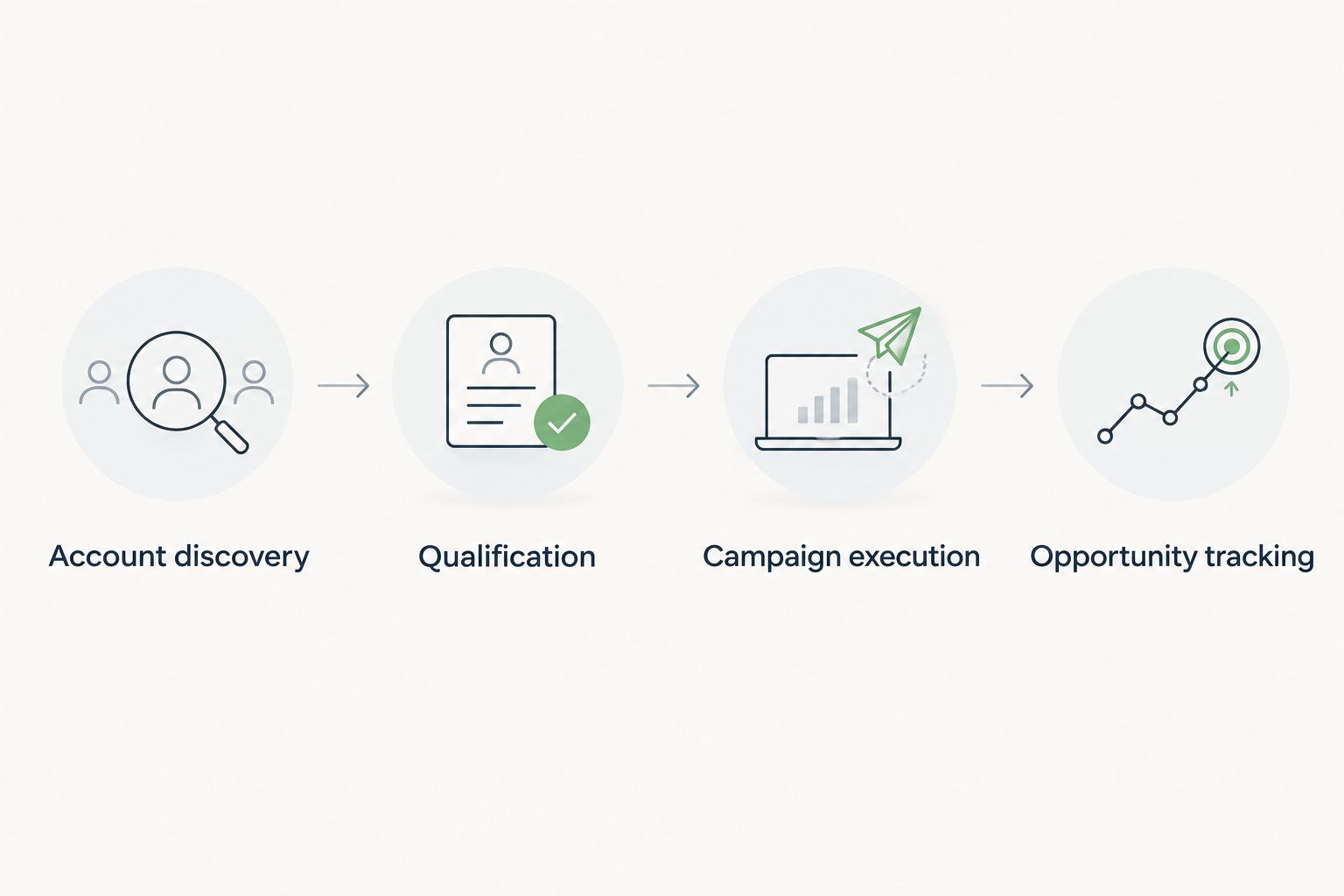
How to connect the tools into a prospecting workflow
For a 2026 conference, choose the workflow before choosing additional tools. Each stage needs a clear output that the next stage can use.
Account discovery
Use professional network search and relevant event directories to identify candidate companies. Keep the source and the reason for inclusion with the account record. Discovery produces candidates, not qualified opportunities.
Qualification
Review audience relevance, commercial fit and timing before approving an account for outreach. If the reason for sponsorship is unclear, investigate it rather than substituting a generic message.
Campaign execution
Translate the qualified account’s commercial context into an outreach brief. Keep the sponsor proposition distinct from a delegate invitation or hosted-buyer invitation, even when the same event is involved.
Opportunity tracking
Record meaningful commercial progress and the next action in the CRM. Track 2 outcomes separately: qualified sponsorship meetings and sponsorship opportunities. Neither should be confused with a contact added to a list.
This sequence separates research decisions from execution and sales follow-up. The hand-off matters: a qualified account needs usable context, not just a name and an email address.
Keep a short reason for inclusion attached to every account. That sentence gives the outreach and sales teams the same starting point and makes weak qualification easier to challenge.
How the options are ranked
The ranking uses audience relevance, contact relevance, qualification clarity, execution fit, commercial traceability and ownership. Each option receives a distinct use case because these are different operational jobs, not interchangeable products.
Managed outbound execution leads when the objective is running sponsor outreach. Professional network search and directories support discovery; a spreadsheet supports qualification; a CRM supports opportunity tracking. The order is a functional recommendation, not a performance test or a claim about comparative conversion rates.
Which sponsor prospecting option should you choose?
Choose the option that addresses the unfinished job in your current process. If you already know which accounts fit but lack campaign execution, another discovery tool does not address that requirement.
- Need candidate companies? Start with professional network search and relevant event directories.
- Need a defensible target list? Establish qualification fields in a structured spreadsheet.
- Need managed outbound delivery? Choose a campaign service suited to B2B event organisers.
- Need control of active conversations? Put ownership, stages and next actions in a CRM.
For an undecided organiser, start by writing down the sponsorship proposition and qualification rules. Then choose execution support around that brief. Do not buy every category merely because each performs a useful function.
Explore managed sponsor outreach
Review outbound email campaign support for international B2B conference organisers.
FAQ
What are the best sponsor prospecting tools for B2B conferences in 2026?
The best choice depends on the task: professional network search for account discovery, directories for event-market research, spreadsheets for qualification and a CRM for opportunity tracking. Choose managed outbound support when campaign execution is the requirement.
Is Outstation a sponsor prospecting database?
Outstation is an outbound campaign service for large international B2B conferences and event organisers, rather than a standalone prospecting database. It runs email campaigns on owned, warmed domains to generate sponsors, hosted buyers and delegates.
Can I use exhibitor lists to find conference sponsors?
Yes, exhibitor lists can provide candidate companies for sponsor research. Qualify each company against your audience and sponsorship proposition; exhibiting elsewhere does not establish sponsorship interest in your event.
Do I need a CRM before starting sponsor outreach?
A CRM is not the starting point for deciding which companies fit your conference. Its role is tracking account history, ownership and commercial progress once you need a shared record of sponsorship conversations.
What should I record when qualifying a sponsor prospect?
Record audience relevance, commercial fit and timing. Add the reason for choosing the contact so the outreach team understands both why the account fits and why that person is relevant.
Should sponsor and delegate outreach use the same message?
No, sponsor and delegate outreach should address their different reasons for participating. A sponsor proposition concerns a commercial relationship with the event; a delegate invitation concerns attendance.
What should I measure beyond the number of prospects found?
Track qualified sponsorship meetings and sponsorship opportunities separately from contacts researched. Keep a clear definition for each outcome so account discovery is not reported as commercial progress.
One last thing
Before adding another tool to your 2026 sponsor prospecting process, ask the team to finish this sentence for each target: This company should sponsor because our audience helps it achieve this commercial objective.
If the answer is only that the company operates in the same industry, the account needs more qualification. A tool can organise that decision or help you act on it; it cannot make a vague sponsorship proposition specific.